
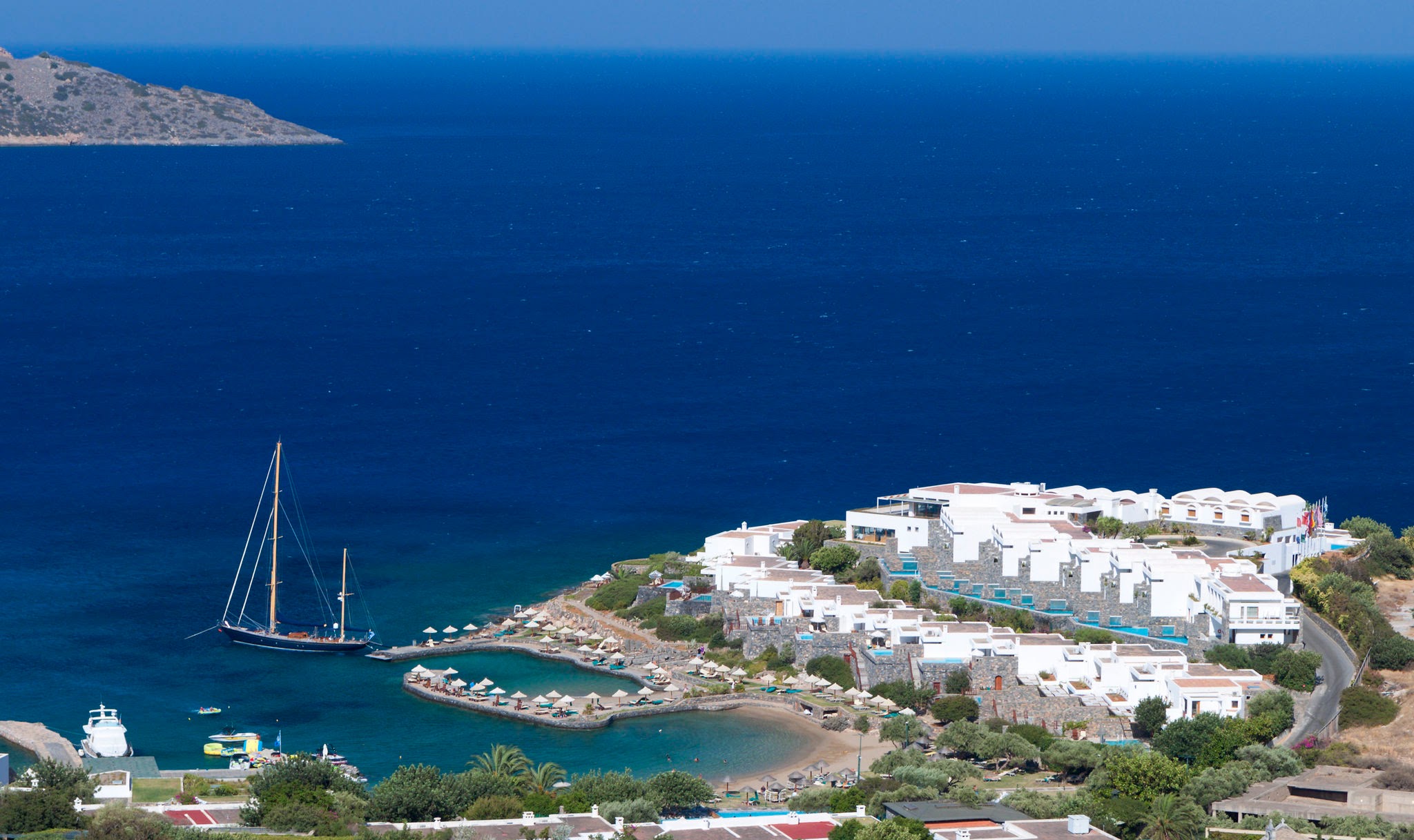
Elounda’s hotel development is easier to understand as a series of clusters rather than a single line of growth. The coast south of the village, the slopes near Plaka, and the larger Mirabello Bay setting each attracted different forms of hotel investment.
The pattern is not separate from the older landscape. The same geography that shaped fishing, salt work, boat routes, and views toward Spinalonga also shaped where hotels were built. For the wider place setting behind those routes and views, read Where the Sea Holds Memory.
1957-1960s: After Spinalonga Closed
The leprosy hospital on Spinalonga closed in 1957. In the years that followed, Elounda and the nearby settlements were still small coastal communities, with fishing, local movement, and village life forming the main public image of the area.
Film and television later helped make the wider Mirabello setting more visible outside Crete. The local research files note the 1964 Disney film The Moon-Spinners and the 1977 BBC series Who Pays the Ferryman? as part of that wider exposure. Those productions did not create the hotel clusters by themselves, but they belong to the same period in which eastern Crete became more legible to outside visitors.
1971-1977: The First Resort Logic Around Elounda
The first major step in the modern hotel story came just outside Elounda. The Elounda SA history records Minos Beach, near Agios Nikolaos, as an early Kokotos family project from 1971.
Elounda itself followed soon after. The same research material records Elounda Bay Palace in 1977, followed by Elounda Beach Hotel. This created the first clear hotel cluster on the central Elounda coast: low-rise resort buildings, sea access, and a model based on views, privacy, and services rather than high-density blocks.
The important point is spatial. Hotels were not placed randomly. They used the protected bay, the coastal road, and the slope of the land.
1982-1992: The Kokotos Cluster Expands
In 1982, the Kokotos family opened Elounda Mare. Elounda SA describes it as the first hotel entirely owned by the family. In 1987, it became the first Greek hotel to join Relais & Chateaux.
Porto Elounda followed in 1992. The Elounda SA history describes it as part of the same family development, with a golf course and a resort layout connected to the existing hotel coastline.
By this stage, the central Elounda hotel cluster had become a defined part of the area’s identity. It sat close to the village, but it was also distinct from older village life in Mavrikiano, Schisma, and the inland routes.
2003-2004: Plaka and the Spinalonga View Become a Second Cluster
The next major shift was north of Elounda, near Plaka. Blue Palace opened in 2003, on the slope facing Spinalonga. In 2004, GTP reported that it had entered one of Starwood’s collection brands.
This mattered because it expanded the hotel map beyond central Elounda. Plaka had already been important for boat access to Spinalonga and for its small coastal settlement. The hotel development added a second cluster, using the direct view to Spinalonga as part of its setting.
2008-2015: Domes and the International Brand Channel
Domes of Elounda was built in 2008, according to Greek Travel Pages. In 2015, GTP reported that Domes of Elounda joined Marriott’s Autograph Collection and became the first Greek and Mediterranean resort in that collection.
This marks another stage in the timeline. The hotel cluster around Elounda was no longer only a local or family-led resort story. It was also being connected to international hotel distribution, loyalty systems, and brand collections.
2022: Repositioning Existing Hotel Assets
The 2020s did not only bring new construction. Some existing hotel assets were repositioned. Hilton lists Domes Aulus Elounda Resort as part of Curio Collection by Hilton, and the research file records the property as a 2022 repositioning of the former Elounda Blu.
This is a different kind of development from building a new coastal resort. It shows how existing hotel sites can be renovated, renamed, and connected to global reservation systems while staying within the same coastal geography.
2023-2030: Larger Mixed-Use Projects
The Elounda Hills project changes the scale of the discussion. GTP reported in 2023 that works had begun, and in 2026 that the project had moved into construction phase. The 2026 GTP report describes an 800 million euro project with target completion before 2030.
This is not just another hotel. The published material describes hotels, residences, and wider infrastructure as part of one planned development. It points to a broader shift from seasonal hotel stays toward mixed hotel and residence models.
2026-2027: New Brand Arrivals and Reopenings
In 2026, Hospitality Net and Tornos reported the opening of INNSiDE by Melia Elounda, developed with Zeus Hotels on the former Elounda Ilion site. This fits the same pattern of reuse and repositioning: an existing hotel site is renovated and brought into a larger international brand system.
Blue Palace is also part of the next phase. Rosewood lists Rosewood Blue Palace as a forthcoming property, while the research files and referenced hotel-industry sources place the reopening plan in 2027. This keeps the Plaka-Spinalonga cluster active, but under a new operating frame.
What the Timeline Shows
Elounda’s hotel clusters developed in stages:
- Central Elounda became the first resort coastline.
- Plaka and the Spinalonga-facing slope formed a second cluster.
- Domes, Hilton, Marriott, Rosewood, Melia, and other brand systems changed how the area connects to international booking channels.
- Newer projects combine hotel rooms, residences, infrastructure, and long-term real-estate planning.
For visitors, the practical result is simple. Elounda is not one hotel strip. It is a set of coastal and hillside zones, each shaped by the bay, the road, the view to Spinalonga, and the older villages behind the waterfront.
For the broader historical setting, read A Short Chronological History of Elounda. For how this changed the visitor economy, read How Elounda’s Visitor Economy Changed.
Sources and Image Credits
- Elounda SA history.
- GTP report on Blue Palace joining Starwood’s collection brand.
- Domes of Elounda joins Autograph Collection, GTP Headlines.
- Domes Aulus Elounda Resort, Hilton.
- Works on Elounda Hills kick off, GTP Headlines.
- Elounda Hills moves into construction phase, GTP Headlines.
- Rosewood Blue Palace, Rosewood Hotels.
- INNSiDE by Melia Elounda opening report, Hospitality Net.
- Local HTML research files provided under
docs/research/elounda/were used as context. - Image credit is shown in the article caption.